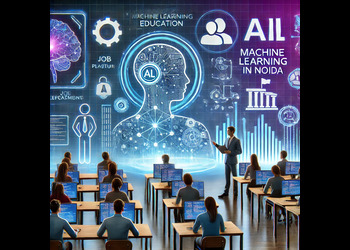
Why Choose Machine Learning Training in Noida?
Noida, a rapidly growing tech hub, offers several advantages for those looking to pursue a Machine Learning career. Here’s why you should consider taking a Machine Learning training course in Noida:
1. Thriving Tech Ecosystem
Noida has emerged as one of the top destinations for IT professionals in India, with a dense concentration of IT companies, tech startups, and multinational corporations in the area. Major companies, especially in the e-commerce, healthcare, banking, and automotive sectors, are incorporating AI and Machine Learning into their core operations. This creates numerous opportunities for ML professionals, and Noida is one of the best places to access these opportunities.
2. High-Quality Training Institutes
The training institutes in Noida are known for offering world-class education in Machine Learning, Python programming, and AI. Many institutes collaborate with renowned global companies and universities to design cutting-edge curriculums and provide high-quality education. With industry experts as trainers and access to state-of-the-art facilities, you’ll be able to receive top-tier training.
3. Real-World Applications and Projects
Hands-on learning is crucial for mastering Machine Learning, and Noida’s training centers offer an extensive curriculum that emphasizes practical application. By working on real-world projects, students gain experience with actual data and problem-solving scenarios, which can be crucial when applying for jobs in the industry.
4. Placement Assistance and Career Growth
Most institutes in Noida offer placement assistance, helping you connect with top-tier tech companies and startups for internships, jobs, and projects. Institutes also provide career counseling, interview preparation, and resume-building services to boost your career prospects.
Core Concepts and Skills Covered in the Machine Learning Training Program
The Machine Learning training course in Noida typically covers the following key areas:
1. Python Programming for Machine Learning
Python is the go-to language for Machine Learning and AI due to its simplicity, versatility, and the availability of several powerful libraries like NumPy, Pandas, Scikit-learn, TensorFlow, and Keras. In the training program, you will learn how to use Python to implement various ML algorithms and handle datasets efficiently.
What You Will Learn:
Introduction to Python: Basics of Python programming, variables, data types, functions, and control structures.
Libraries and Tools: How to work with Python libraries like NumPy, Pandas, Matplotlib, Seaborn, and Scikit-learn for data analysis and visualization.
Data Manipulation: Learn how to preprocess data, clean data, and handle missing values using Python.
Working with Datasets: Learn how to load, explore, and prepare datasets for Machine Learning.
Learning Outcomes:
Gain proficiency in Python programming for data science and machine learning tasks.
Use libraries like Pandas and NumPy for efficient data manipulation and analysis.
2. Deep Learning Fundamentals
Deep Learning is an advanced subset of Machine Learning that focuses on algorithms inspired by the structure of the human brain, namely neural networks. As industries increasingly rely on deep learning for image recognition, speech processing, and natural language understanding, knowledge of these techniques has become essential.
What You Will Learn:
Introduction to Neural Networks: Learn how basic neural networks work and their applications in real-time problems.
Activation Functions: Understand sigmoid, ReLU, and other activation functions and their role in training models.
Training Deep Neural Networks: Learn the process of training deep learning models using backpropagation and gradient descent.
Convolutional Neural Networks (CNNs): Master CNNs for applications in image recognition, object detection, and computer vision.
Recurrent Neural Networks (RNNs): Learn how RNNs and Long Short-Term Memory (LSTM) networks are used for sequential data, such as speech recognition and text prediction.
Learning Outcomes:
Implement and train deep learning models for various applications like image processing, video analytics, and language processing.
Understand and apply advanced deep learning architectures like CNNs and RNNs.
3. Artificial Intelligence (AI) Concepts
Artificial Intelligence (AI) refers to machines performing tasks that would typically require human intelligence. The AI modules in the training program cover core concepts like machine learning, knowledge representation, problem-solving techniques, and intelligent agents.
What You Will Learn:
Introduction to AI: Understand the core concepts and foundations of AI.
Problem Solving with AI: Learn algorithms such as A search*, minimax, and alpha-beta pruning for problem-solving in AI.
Expert Systems: Learn how expert systems use knowledge bases to make decisions.
Reinforcement Learning: Understand how agents can learn from interacting with environments and receiving rewards or penalties.
Learning Outcomes:
Develop an understanding of AI techniques and their applications in real-world scenarios.
Gain the skills to design and develop intelligent systems and agents.
4. Machine Learning Algorithms
A fundamental part of Machine Learning is understanding various algorithms and how they function. The training program covers both supervised and unsupervised learning techniques, which are widely used in different applications.
What You Will Learn:
Supervised Learning Algorithms: Learn about linear regression, logistic regression, decision trees, random forests, and support vector machines (SVM).
Unsupervised Learning Algorithms: Understand k-means clustering, hierarchical clustering, principal component analysis (PCA), and anomaly detection techniques.
Model Evaluation: Learn how to assess model performance using metrics like accuracy, precision, recall, and F1 score.
Learning Outcomes:
Gain a solid understanding of key Machine Learning algorithms and their use cases.
Learn how to evaluate, optimize, and deploy machine learning models.
5. Real-World Projects and Case Studies
One of the most valuable aspects of Machine Learning training is the opportunity to work on real-world projects. These projects simulate business problems and give you a chance to implement what you've learned in real-life scenarios.
Types of Projects:
Predictive Analytics: Build models to predict future outcomes, such as sales forecasting, customer churn prediction, or stock market predictions.
Image Classification: Work on a project to classify images into categories using Convolutional Neural Networks (CNNs).
Text Analysis: Use Natural Language Processing (NLP) to analyze and classify text data, such as customer reviews or tweets.
Recommendation Systems: Build a collaborative filtering recommendation system to suggest products or services to users.
Learning Outcomes:
Apply ML algorithms to real-world datasets and develop an understanding of practical ML challenges.
Build a portfolio of projects to demonstrate your skills to potential employers.
Job Opportunities After Machine Learning Training
Upon completing your Machine Learning training in Noida, a wide range of career opportunities await you. As businesses continue to leverage AI and ML technologies, there is an increasing demand for skilled professionals in various sectors:
Common Job Roles:
Machine Learning Engineer: Develop machine learning models and algorithms.
Data Scientist: Analyze and interpret complex data to help companies make informed decisions.
AI Research Scientist: Conduct research to create new AI and machine learning technologies.
Deep Learning Engineer: Specialize in training and deploying deep learning models for applications like computer vision and NLP.
Business Intelligence Analyst: Use ML techniques to analyze business data and optimize business processes.
Top Industries Hiring Machine Learning Professionals:
E-commerce: Predict customer behavior and personalize recommendations.
Healthcare: Use ML for medical imaging, drug discovery, and predictive healthcare analytics.
Finance: Implement fraud detection, risk analysis, and trading algorithms.
Automotive: Develop autonomous vehicle systems and intelligent navigation.
Manufacturing: Optimize production processes and predictive maintenance.
Conclusion
Machine Learning training in Noida, with a focus on Python, Deep Learning, and AI, provides you with the tools and knowledge necessary to excel in the tech-driven world. The courses offer hands-on experience, access to industry experts, and the opportunity to work on real-time projects, making you industry-ready and setting you on the path to a successful career in AI and Machine Learning. Whether you’re a beginner or looking to deepen your existing knowledge, the training program in Noida offers everything you need to thrive in one of the fastest-growing fields in the tech industry.
Comments (0)

Categories
Recent posts
Machine Learning Course in Delhi: Learn ...
11 Feb 2025
Top 10 Machine Learning Institutes in ...
11 Feb 2025.png)
Top Programming Languages for Full Stack ...
5 Aug 2024