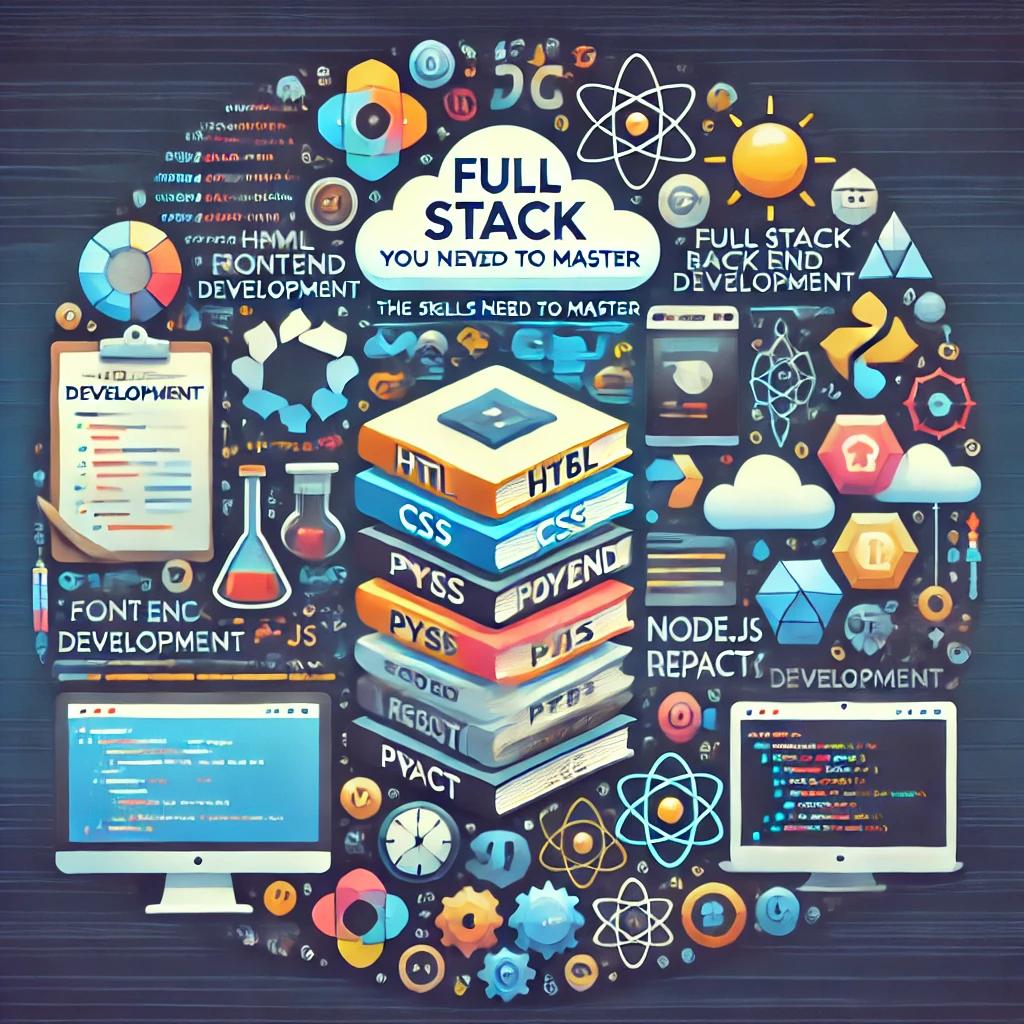
Full-stack development is a highly sought-after skill in today's tech-driven world. It
encompasses the ability to work on both the front-end (user interface) and back-end
(server-side) of web applications. This versatility makes full-stack developers highly
valuable assets in the tech industry.
Key Skills to Master as a Full-Stack Developer:
Front-End Development:
HTML, CSS, and JavaScript: These are the foundational languages of the web.
HTML provides the structure of a webpage (headings, paragraphs, images).
CSS handles the visual presentation (colors, fonts, layout).
JavaScript adds interactivity (animations, user input handling, dynamic content).
Front-End Frameworks:
React: A popular JavaScript library for building user interfaces, known for its
component-based architecture and performance.
Angular: A powerful framework for building complex applications, offering a
comprehensive solution with built-in features.
Vue.js: A progressive framework that is easy to learn and integrate into existing
projects.
UI/UX Design Principles: A basic understanding of user interface and user
experience design principles is crucial to create user-friendly and engaging web
applications.
Back-End Development:
Server-Side Languages:
Python (with frameworks like Django and Flask): A versatile language known for its
readability and extensive libraries.
Node.js (with JavaScript): Enables server-side JavaScript execution, allowing for
efficient and scalable applications.
Ruby (with Ruby on Rails): A highly productive framework that emphasizes
convention over configuration.
Java (with Spring Boot): A robust and widely used platform for enterprise-level
applications.
Databases:
RelationalDatabases (SQL): Learn SQL (Structured Query Language) to interact
with databases like MySQL, PostgreSQL, and SQL Server.
NoSQL Databases: Explore NoSQL databases like MongoDB and Cassandra for
flexible data storage and retrieval.
APIs (Application Programming Interfaces): Understand how to build and consume
APIs to enable communication between different parts of an application or with
external services.
Other Essential Skills:
Version Control (Git): Learn to use Git for tracking code changes, collaborating with
other developers, and managing different versions of your projects.
Command Line Interface (CLI): Become comfortable working with the command line
for various tasks like navigating files, running commands, and managing projects.
Problem-Solving and Debugging: Develop strong problem-solving and debugging
skills to identify and fix issues in your code efficiently.
Communication and Collaboration: Effective communication and collaboration are
crucial when working in a team environment.
Learning Resources:
Online Courses: Platforms like Coursera, Udemy, edX, and freeCodeCamp offer a
wide range of full-stack development courses.
Interactive Coding Platforms: Websites like Codecademy, HackerRank, and
LeetCode provide interactive coding challenges and exercises.
Personal Projects: Build personal projects to apply your knowledge and gain
practical experience. Start with small projects and gradually increase complexity.
Open-Source Contributions: Contribute to open-source projects to learn from
experienced developers and gain real-world experience.
Online Documentation and Tutorials: Utilize online documentation and tutorials to
learn about specific technologies and solve coding challenges.
Tips for Success:
Consistency is Key: Dedicate regular time for learning and practice.
Focus on Fundamentals: Build a strong foundation in core concepts before diving
into advanced topics.
Break Down Complex Problems: Divide complex problems into smaller, more
manageable tasks.
Seek Help and Guidance: Don't hesitate to seek help from online communities,
mentors, or fellow learners.
Stay Updated: The tech world is constantly evolving, so stay updated with the latest
trends and technologies.
Conclusion:
Becoming a full-stack developer requires dedication, hard work, and continuous
learning. By mastering the skills outlined in this blog post and consistently practicing,
you can build a successful career in the exciting and rewarding field of web
development
Comments (0)
Categories
Recent posts

Machine Learning Course in Delhi: Learn ...
11 Feb 2025
Top 10 Machine Learning Institutes in ...
11 Feb 2025.png)
Top Programming Languages for Full Stack ...
5 Aug 2024