Introduction
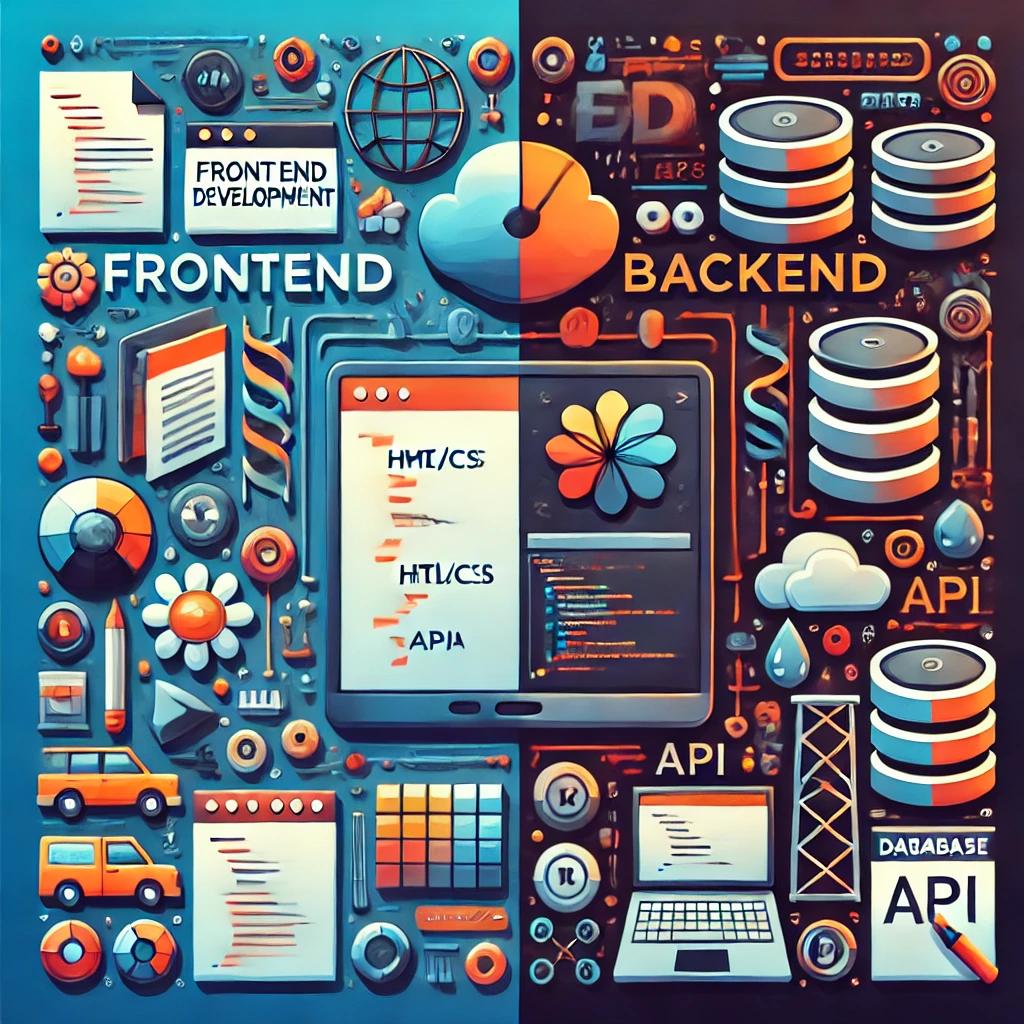
In the world of web development, you’ll often hear the terms “frontend” and “backend” thrown around. These two crucial aspects work together seamlessly to create the websites and applications we interact with daily. But what exactly differentiates them? This blog post will delve into the intricacies of frontend and backend development, explaining their roles, responsibilities, and the technologies involved.
What is Frontend Development?
Frontend development focuses on everything users directly interact with on a website or application. This includes:
User Interface (UI) Design: The visual presentation and layout of the website, including colors, fonts, images, and overall aesthetics.
User Experience (UX) Design: How users interact with the website, ensuring ease of navigation, intuitive features, and a positive overall experience.
HTML, CSS, and JavaScript: These are the core programming languages used to build the frontend.
HTML provides the structure (the bones) of the webpage.
CSS handles the styling and presentation (the skin and clothes).
JavaScript adds interactivity and dynamic behavior (the life).
What is Backend Development?
Backend development deals with the server-side of a website or application. It focuses on:
Server-side Logic: Handling data storage, retrieval, and processing.
Database Management: Creating, managing, and querying databases to store and retrieve information.
Server-side Languages: Languages like Python (with frameworks like Django and Flask), Ruby on Rails, Node.js, Java, and PHP are commonly used.
APIs (Application Programming Interfaces): These allow communication between the frontend and backend, enabling data exchange and functionality.
Key Differences Between Frontend and Backend Development
Feature Frontend Development Backend Development
Focus User Interface & User Experience Server-side Logic & Data Management
Interaction Directly interacts with users Operates behind the scenes
Technologies HTML, CSS, JavaScript Python, Ruby, Node.js, Java, PHP
Tools Code editors, browsers, UI/UX design tools Integrated Development Environments (IDEs), databases, servers
Skills Creativity, visual design, user empathy Problem-solving, data structures, algorithms
Export to Sheets
Frontend vs Backend: A Simple Analogy
Imagine a restaurant.
Frontend: The waiters, the menu, the dining area, and the overall ambiance experienced by the customers.
Backend: The kitchen, where the food is prepared, the chefs, the storage of ingredients, and the supply chain.
Which Path is Right for You?
Choosing between frontend and backend development depends on your interests and skills.
Frontend: If you’re creative, enjoy visual design, and prioritize user experience, frontend development might be a good fit.
Backend: If you’re passionate about problem-solving, enjoy working with data, and have a strong interest in logic and algorithms, backend development could be your calling.
Conclusion
Both frontend and backend development are essential for creating a complete and functional website or application. Understanding their roles and differences is crucial for anyone interested in pursuing a career in web development. By working together, frontend and backend developers build the digital experiences we encounter every day.
Comments (0)

Categories
Recent posts


Machine Learning Course in Delhi: Learn ...
11 Feb 2025
Top 10 Machine Learning Institutes in ...
11 Feb 2025.png)
Top Programming Languages for Full Stack ...
5 Aug 2024