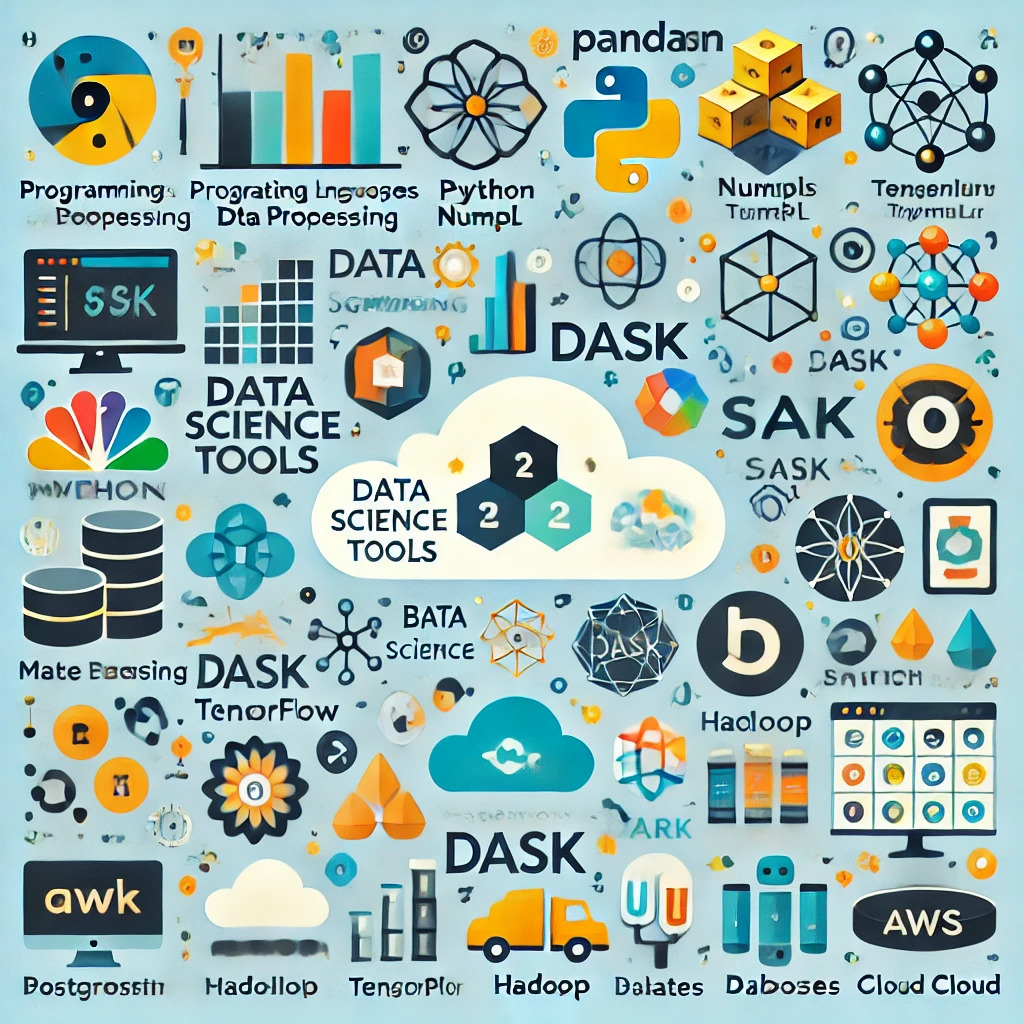
📊 Data Science Tools by Category
1️⃣ Data Collection & Storage Tools
Data scientists need tools to gather, store, and manage structured and unstructured data from various sources.
📥 Data Collection & Web Scraping:
Scrapy 🕷 – Web scraping framework for extracting data from websites.
BeautifulSoup 🍲 – Parser HTML and XML documents to extract structured data.
Selenium 🌍 – Automates browser interactions for web scraping.
Open Data Portals 🌎 – Kaggle, Google Dataset Search, Government APIs.
💾 Databases & Storage:
SQL Databases 💾 – MySQL, PostgreSQL, SQLite (for structured data).
NoSQL Databases 📦 – MongoDB, Cassandra, Firebase (for unstructured data).
Data Lakes & Warehouses 🏞 – Amazon S3, Google BigQuery, Snowflake (for large-scale storage).
2️⃣ Data Cleaning & Preprocessing Tools
Raw data is often incomplete, noisy, and inconsistent. These tools help in cleaning and preparing data for analysis.
🧹 Data Cleaning & Transformation:
Pandas 🐼 – Python library for data manipulation (handling missing values, filtering, merging).
NumPy 🔢 – Numerical computing, handling multi-dimensional arrays.
OpenRefine 🛠 – Data cleaning for large messy datasets.
📏 Data Standardization & Encoding:
Scikit-learn 📊 – Provides preprocessing functions for normalization, scaling, and encoding categorical variables.
3️⃣ Data Analysis & Statistical Computing Tools
Exploratory Data Analysis (EDA) helps in identifying trends, patterns, and insights in data.
📈 Statistical Analysis:
R 📊 – Best for statistical computing and visualization.
SciPy 🔬 – Scientific computing for probability distributions and hypothesis testing.
📊 Data Exploration & Feature Engineering:
Seaborn 🎨 – High-level statistical visualization in Python.
Matplotlib 🖼 – Basic plotting library for line, bar, and scatter plots.
Dask ⚡ – Handles large datasets that don't fit into memory.
4️⃣ Data Visualization Tools
Data visualization helps communicate insights effectively using interactive charts and dashboards.
🎨 Python Visualization Tools:
Matplotlib & Seaborn – Static visualizations for EDA.
Plotly & Bokeh – Interactive visualizations for web applications.
📊 Business Intelligence & Dashboarding:
Tableau 📊 – Drag-and-drop BI tool for data dashboards.
Power BI ⚡ – Microsoft’s data visualization and reporting tool.
Google Data Studio 🌍 – Free tool for creating shareable reports.
5️⃣ Machine Learning & AI Tools
Machine Learning (ML) and Artificial Intelligence (AI) tools help in building predictive models.
🤖 Core ML Libraries & Frameworks:
Scikit-learn 🔧 – The go-to Python library for classical ML models.
XGBoost 🚀 – Optimized gradient boosting for high-performance ML models.
LightGBM 🌱 – Fast and efficient gradient boosting for large datasets.
CatBoost 🐱 – Handles categorical data natively for better performance.
🧠 Deep Learning & Neural Networks:
TensorFlow 🔥 – Google's open-source deep learning framework.
PyTorch ⚙️ – Research-friendly deep learning framework from Facebook AI.
Keras 🏗 – High-level deep learning API built on TensorFlow.
🎭 Natural Language Processing (NLP):
NLTK 🗣 – Natural language toolkit for text processing.
spaCy ⚡ – Efficient NLP library for entity recognition, dependency parsing.
Transformers (Hugging Face) 🤗 – Pretrained AI models for NLP (BERT, GPT, T5).
🖼 Computer Vision:
OpenCV 👀 – Image processing and computer vision tasks.
YOLO (You Only Look Once) 🏃♂️ – Real-time object detection.
6️⃣ Big Data & Cloud Computing Tools
Handling large-scale data requires distributed computing and cloud-based storage.
📀 Big Data Technologies:
Hadoop 🏗 – Distributed file system for processing massive datasets.
Apache Spark 🔥 – Fast, in-memory big data processing.
☁ Cloud Computing & Storage:
AWS (Amazon Web Services) ☁ – S3 (storage), EC2 (compute), Lambda (serverless).
Google Cloud Platform (GCP) 🌎 – BigQuery, AI Platform, Vertex AI.
Microsoft Azure 🔷 – Azure ML, Blob Storage, Databricks.
7️⃣ Model Deployment & MLOps Tools
After building ML models, deployment and monitoring are crucial.
🚀 Model Deployment Platforms:
Flask & FastAPI 🌍 – Lightweight web frameworks for deploying ML models.
Docker 🐳 – Containerization for reproducible environments.
Kubernetes ⛵ – Orchestration of ML workloads at scale.
🔄 MLOps & Model Monitoring:
MLflow 🔄 – Model tracking and experiment management.
Kube Flow ⚙️ – End-to-end MLOps pipeline on Kubernetes.
TensorFlow Serving 🍽 – Scalable model serving system.
🎯 Why Learning These Tools is Essential for Data Scientists
✅ Efficiency: These tools automate repetitive tasks, saving time.
✅ Scalability: They enable working with large datasets and real-time data.
✅ Accuracy: Advanced algorithms and ML models improve predictions.
✅ Collaboration: Tools like Git, Jupyter Notebooks, and cloud platforms allow team-based workflows.
✅ Industry Relevance: Most companies use these tools for real-world applications.
📜 Conclusion
Data Science is a fast-growing field that requires proficiency in various tools and technologies to handle complex data challenges. From data collection and analysis to AI model deployment and monitoring, each stage of the Data Science workflow relies on specialized tools.
At Mellow Academy, we ensure that learners gain hands-on experience with the most in-demand tools, making them job-ready for careers in Data Science, AI, and Big Data.
Comments (0)

Categories
Recent posts

Machine Learning Course in Delhi: Learn ...
11 Feb 2025
Top 10 Machine Learning Institutes in ...
11 Feb 2025.png)
Top Programming Languages for Full Stack ...
5 Aug 2024